

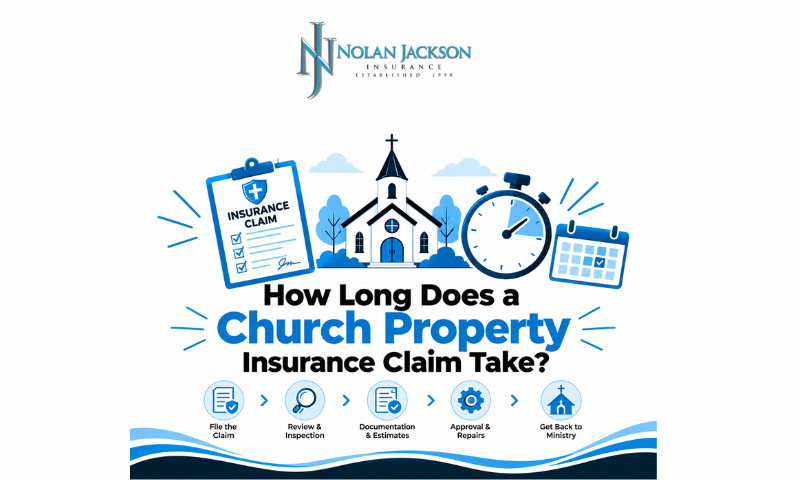
When a church suffers property damage, one of the first questions we hear is: How long does a church property insurance claim take? The answer depends on the type and severity of the loss, the complexity of the damage, the availability of documentation, the insurance company’s investigation, and whether there are questions about coverage.
A relatively straightforward claim may move from initial report to resolution in a matter of weeks. More complicated claims involving major structural damage, extensive water damage, fire, storm damage, multiple buildings, specialized property, or significant rebuilding costs can take several months or longer.
Understanding the church insurance claims process can help pastors, administrators, trustees, and church leadership teams know what to expect and take practical steps to avoid unnecessary delays.
Average Timeline for a Church Property Insurance Claim
There is no universal timeline for every church property claim. Each loss is evaluated according to its individual circumstances.
A typical claim may progress through these stages:
- The loss occurs
- The church takes emergency measures to protect people and property
- The claim is reported
- An adjuster is assigned
- The damage is inspected and documented
- Coverage is reviewed
- Repair or replacement estimates are prepared
- Additional investigation occurs when necessary
- The insurer determines the covered amount
- Payment or settlement is issued
- Repairs or reconstruction proceed
A simple covered loss may be resolved relatively quickly. A complex claim can take substantially longer because several parties may need to investigate, estimate, document, and negotiate the loss.
What Determines How Long a Church Insurance Claim Takes?
1. The Severity of the Property Damage
The size and complexity of the loss are major factors.
A small water leak affecting one room may require relatively limited investigation. By contrast, a major fire affecting a sanctuary, classrooms, offices, electrical systems, HVAC equipment, and contents can require extensive documentation.
The larger the loss, the more likely it is that the claim will involve:
- Multiple inspections
- Engineers
- Contractors
- Restoration companies
- Specialized estimators
- Building consultants
- Inventory documentation
- Structural assessments
- Multiple rounds of estimates
These additional steps can extend the church property insurance claim timeline.
2. The Cause of the Loss
The cause of damage can affect the complexity of the investigation.
Common church property losses include:
- Fire
- Wind
- Hail
- Lightning
- Water damage
- Frozen pipes
- Roof damage
- Electrical failures
- Equipment breakdown
- Vandalism
- Theft
- Certain weather-related losses
If the cause is straightforward and clearly falls within the policy, the claim may proceed more efficiently.
When the cause of loss is disputed or requires specialized investigation, the process may take longer.
3. Policy Coverage and Exclusions
Another important factor is whether the loss is covered by the church’s policy.
Insurance policies contain coverage provisions, exclusions, conditions, deductibles, limits, and endorsements that determine how a claim is handled.
Questions may arise concerning:
- Whether the cause of loss is covered
- Whether an exclusion applies
- Whether special deductibles apply
- Whether the property was properly insured
- Whether certain buildings are listed
- Whether specific equipment is covered
- Whether additional coverage applies
- Whether policy conditions have been satisfied
A claim involving a straightforward covered event can generally move more smoothly than one requiring extensive coverage analysis.
Church Property Insurance Claim Process
Step 1: Protect People and Prevent Further Damage
The first priority following a church property loss should always be life safety.
After addressing immediate safety concerns, the church should take reasonable steps to prevent additional damage when it is safe to do so.
For example, after a significant water loss, appropriate emergency measures might include shutting off the water source and contacting a qualified restoration professional.
Church leaders should avoid unnecessary repairs that could interfere with the investigation, while still taking reasonable action to prevent additional damage.
Step 2: Report the Claim Promptly
Churches should notify the appropriate insurance representative or carrier as soon as reasonably possible after a covered loss.
Prompt reporting allows the insurer to begin the claims process and determine what investigation is needed.
Waiting too long can create complications, particularly when damage continues to worsen.
Step 3: Document the Damage
Documentation is an important part of the church insurance claim process.
We recommend maintaining photographs and videos of damaged areas when it is safe to do so.
Church leaders should also preserve relevant:
- Receipts
- Invoices
- Repair estimates
- Contractor proposals
- Equipment records
- Property inventories
- Purchase documentation
- Maintenance records
- Building plans
- Other relevant documents
Detailed documentation can make it easier to establish the nature and extent of the loss.
Step 4: Insurance Adjuster Inspection
An insurance adjuster may inspect the property to assess the damage and investigate the circumstances surrounding the loss.
For significant claims, additional professionals may become involved.
Depending on the circumstances, these could include engineers, building consultants, restoration professionals, or specialized experts.
Step 5: Damage Assessment and Estimates
The church and insurance representatives may need to determine the cost of repairing or replacing damaged property.
For a major building loss, estimates may cover:
- Structural repairs
- Roofing
- Flooring
- Walls and ceilings
- Electrical systems
- Plumbing
- HVAC
- Windows and doors
- Fire protection systems
- Interior finishes
- Specialized church property
The complexity of estimating these costs can significantly affect the claim timeline.
Step 6: Coverage Determination
The insurer reviews the facts of the loss against the applicable policy provisions.
This is where policy limits, exclusions, deductibles, endorsements, valuation provisions, and other conditions become especially important.
If the coverage determination is straightforward, the claim can move forward more quickly.
If there are coverage questions, additional investigation may be necessary.
Step 7: Settlement and Payment
Once the insurer has completed the necessary investigation and established the covered amount, payment may be issued according to the policy terms.
Some claims may involve multiple payments rather than one single payment, particularly when repairs and reconstruction occur over an extended period.
How Long Does a Church Roof Insurance Claim Take?
A church roof insurance claim can range from relatively simple to highly complex.
A small covered roof repair may be evaluated and resolved quickly. A major storm loss involving extensive roof damage, interior water intrusion, damaged equipment, and structural concerns can require considerably more time.
Roof claims can also become complicated when the insurer needs to determine:
- The cause of damage
- The age and condition of the roof
- Whether damage is storm-related
- Whether maintenance issues contributed to the loss
- Applicable deductibles
- Replacement-cost provisions
- Whether interior damage resulted from the covered event
Maintaining roof inspections and maintenance records can provide valuable documentation when a claim occurs.
How Long Does a Church Fire Insurance Claim Take?
Fire claims are often among the most complicated church property claims.
A serious church fire can affect the building, contents, electrical systems, HVAC, furnishings, technology, documents, sound equipment, religious items, and other property.
The insurer may need to investigate both the cause of the fire and the extent of the damage.
Structural engineers and specialized contractors may be needed to determine whether portions of the building can be repaired or must be rebuilt.
Because of these factors, a major church fire claim can take months or longer to fully resolve.
How Long Does a Church Water Damage Claim Take?
Water damage claims vary significantly.
A localized plumbing failure may be addressed relatively quickly. Extensive water damage can require:
- Emergency water extraction
- Drying
- Mold prevention
- Removal of damaged materials
- Structural assessment
- Plumbing repairs
- Reconstruction
- Replacement of contents
If hidden moisture or secondary damage is discovered, the claim may become more complicated.
Promptly addressing water intrusion is important because delaying mitigation can allow damage to spread.
What Can Delay a Church Property Insurance Claim?
Several issues can contribute to delays.
Incomplete Documentation
Missing receipts, inventories, property records, photographs, or estimates can make it more difficult to establish the value of the loss.
Unclear Cause of Loss
If it is unclear what caused the damage, the insurer may need additional investigation.
Coverage Disputes
Questions about exclusions, policy conditions, limits, or endorsements can extend the process.
Large or Complex Losses
Major claims naturally require more investigation and documentation.
Contractor Availability
Even after a claim is approved, obtaining qualified contractors and materials can delay reconstruction.
Building Code Requirements
Rebuilding an older church may require compliance with current building codes, accessibility requirements, or other regulations.
Specialized Property
Churches may contain organs, stained glass, artwork, historical items, sound systems, audiovisual equipment, or custom architectural features that require specialized evaluation.
How Churches Can Help Speed Up an Insurance Claim
Church leaders cannot control every part of the claims process, but they can take steps to keep their documentation organized.
Maintain a Current Property Inventory
Keep an updated inventory of significant church property, including photographs, descriptions, purchase information, and other available documentation.
Review Insurance Limits Regularly
A church should periodically review whether its building insurance limit reflects current replacement costs.
Construction costs can change significantly over time.
Keep Maintenance Records
Documentation of roof inspections, HVAC maintenance, plumbing work, electrical work, and other major maintenance can be useful following a loss.
Know the Church’s Deductibles
Church leadership should understand applicable property deductibles before a claim occurs.
Identify Valuable Property
Specialized or high-value items should be discussed with the insurance professional to determine whether they require special treatment or scheduling.
Understand the Policy Before a Loss
The best time to identify potential coverage gaps is before damage occurs.
Church leaders should understand their building coverage, contents coverage, liability protection, deductibles, exclusions, endorsements, and other important provisions.
What Should a Church Do If an Insurance Claim Is Taking Too Long?
If a claim appears to be delayed, church leadership should maintain communication with the appropriate insurance representative and ask for an update on the claim’s status.
Useful questions may include:
- Has an adjuster been assigned?
- Has the property inspection been completed?
- Is additional documentation needed?
- Are there outstanding estimates?
- Are there unresolved coverage questions?
- Has the insurer identified additional information required?
- What is the next step in the claims process?
Keeping a written record of communications and submitting requested documentation promptly can help maintain an organized claims process.
For questions involving claim disputes or applicable legal rights, churches should consider obtaining advice from an appropriately qualified insurance or legal professional.
Protect Your Church Before a Property Loss Occurs
A church insurance claim is much easier to manage when the organization already has appropriate coverage, accurate property valuations, organized records, and a clear understanding of its policy.
We encourage church leaders to review their insurance program before a loss occurs rather than discovering coverage gaps after a fire, storm, water loss, or other unexpected event.
At Nolan Jackson Insurance, we help churches evaluate their insurance needs and understand the protection available for their buildings, property, ministries, employees, volunteers, and other exposures.
Talk With Nolan Jackson Insurance About Church Coverage
If your church needs help reviewing its church property insurance, building coverage, liability protection, or overall insurance program, contact Nolan Jackson Insurance.
We can help you evaluate your current coverage, identify areas that may need attention, and develop an insurance strategy appropriate for your church’s unique operations and property.
Contact Nolan Jackson Insurance today to discuss your church insurance needs and make sure your organization is prepared before a property loss occurs.
Church Property Insurance Claim FAQs
How long does a church property insurance claim usually take?
There is no standard timeframe. A straightforward claim may take weeks, while a complex loss involving major structural damage, fire, extensive water damage, or multiple buildings can take several months or longer.
How quickly should a church report property damage?
A church should generally report a potential claim promptly and follow the notice requirements in its policy. Early reporting can allow the insurer to begin its investigation and help address additional damage.
Can a church start repairs before the insurance company inspects the damage?
Emergency measures to protect people and prevent additional damage may be appropriate, but churches should generally document the damage and coordinate with the insurer before undertaking major permanent repairs when possible.
Does a church insurance claim always result in a payment?
No. A claim payment depends on the applicable policy provisions, including coverage, exclusions, deductibles, limits, and the circumstances of the loss.
What documents should a church keep for an insurance claim?
Important documentation may include photographs, videos, receipts, invoices, inventories, maintenance records, contractor estimates, property records, and other evidence establishing the condition and value of the property.
Why can large church insurance claims take so long?
Large claims may involve multiple buildings, extensive damage, engineering assessments, detailed inventories, reconstruction estimates, specialized property, coverage questions, and multiple contractors or consultants.
Can a church insurance claim cover rebuilding costs?
Potentially, depending on the policy’s building coverage, valuation provisions, limits, deductibles, endorsements, and other conditions. Churches should understand whether their coverage is based on replacement cost or another valuation method.
What happens if the church’s insurance limit is too low?
Underinsurance can create significant financial challenges following a major loss. Certain policy provisions, including coinsurance requirements, may also affect claim payments. Churches should periodically review their property valuations and limits.
Should churches review their insurance policies every year?
Yes. Annual reviews can help identify changes in buildings, property values, operations, ministries, vehicles, employees, programs, and other exposures that may affect insurance needs.