

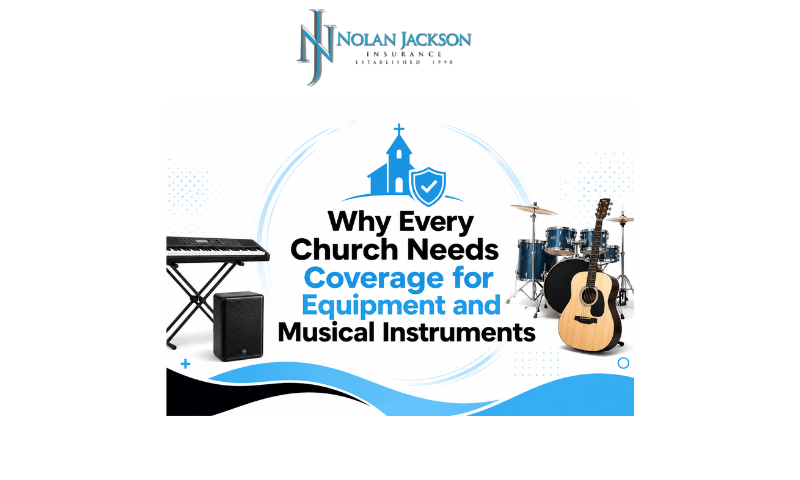
Churches are more than places of worship. They are gathering places where communities come together for services, music, education, outreach, fellowship, and special events. To support these activities, churches often rely on a substantial collection of musical instruments, sound equipment, audiovisual technology, computers, furniture, and other valuable property.
Unfortunately, these items can be vulnerable to theft, fire, storms, electrical damage, vandalism, and other unexpected events. Replacing a damaged church organ, piano, drum set, soundboard, microphones, speakers, or projection system can cost thousands of dollars. Without appropriate insurance protection, the financial burden may fall directly on the church and its congregation.
For this reason, church insurance should include appropriate coverage for equipment and musical instruments. At Nolan Jackson Insurance, we help organizations understand their insurance needs and identify coverage options designed to protect the property and resources they depend on.
Why Church Equipment and Musical Instruments Need Insurance
Churches may own property that is significantly more valuable than it appears at first glance. A worship space might contain an acoustic piano, electronic keyboards, guitars, drums, amplifiers, microphones, mixers, speakers, lighting equipment, computers, televisions, projectors, cameras, and other technology.
Some churches also maintain specialized equipment for livestreaming services, recording sermons, producing worship music, or hosting community events.
When these items are damaged or stolen, the cost of replacing them can be substantial. A single incident involving a fire, burglary, water damage, or severe storm could affect numerous pieces of equipment simultaneously.
Church property insurance can help protect these important assets against covered losses, depending on the policy terms, exclusions, limits, and deductibles.
The right coverage gives church leaders greater confidence that an unexpected property loss will not immediately disrupt ministry operations or create an unplanned financial crisis.
Common Church Equipment That May Need Coverage
Every congregation has different property and operational needs. A church insurance review should account for the equipment actually owned, leased, borrowed, or used by the organization.
Common items that may require consideration include:
- Pianos and organs
- Acoustic and electric guitars
- Bass guitars
- Drum kits and percussion instruments
- Keyboards and synthesizers
- Brass and woodwind instruments
- Amplifiers
- Microphones and wireless microphone systems
- Speakers and subwoofers
- Mixing consoles and soundboards
- Audio recording equipment
- Stage and worship lighting
- Projectors and projection screens
- Televisions and display monitors
- Computers and laptops
- Cameras and video equipment
- Livestreaming equipment
- Musical accessories and cases
- Portable sound systems
- Church office equipment
The value of these items can add up quickly. Maintaining an accurate inventory can help church administrators determine whether existing insurance limits are adequate.
Protecting Musical Instruments Used in Worship Services
Music is an important part of worship for many congregations. Churches may invest significant amounts of money in instruments used by worship teams, choirs, musicians, and professional performers.
Musical instruments can be particularly important to insure because some are expensive, difficult to replace, or highly specialized.
A church may own a high-quality piano, pipe organ, electronic organ, guitars, percussion equipment, or other instruments that have considerable replacement value. Some churches may also possess vintage or specialty instruments.
Insurance considerations can become more complicated when an instrument is borrowed, rented, leased, donated, or owned by an individual musician. Church leaders should not automatically assume that every item used inside the building is covered in the same way.
We recommend discussing ownership and usage arrangements with an insurance professional so the appropriate coverage can be evaluated.
What Can Happen Without Adequate Church Insurance?
Without adequate insurance, a church may have to pay out of pocket to repair or replace damaged property.
Consider a situation in which a church experiences an electrical fire. The damage might extend beyond the building itself. Smoke, heat, soot, and water used to extinguish the fire could damage musical instruments, sound equipment, computers, furniture, and other property.
Another possibility is theft. A burglar could take expensive microphones, guitars, laptops, cameras, amplifiers, or other portable equipment.
Severe weather can also cause property damage. Roof leaks, wind, hail, flooding, and other weather-related events may affect church property.
Even a relatively small incident can become expensive when multiple pieces of equipment need to be repaired or replaced.
Church Property Insurance and Equipment Coverage
A comprehensive church insurance program can address multiple aspects of an organization’s risk.
Property coverage may help protect the church building and eligible contents against covered causes of loss. Depending on the policy, this may include certain risks such as fire, theft, vandalism, or specified weather-related damage.
However, churches should pay close attention to coverage limits, deductibles, exclusions, valuation methods, and special limitations.
For example, a policy’s general contents limit may not necessarily provide the level of protection a church expects for a particularly valuable instrument or specialized piece of equipment.
That is why a detailed insurance review is important.
Replacement Cost vs. Actual Cash Value
One important issue for churches to understand is how damaged property will be valued.
Replacement cost generally refers to the amount needed to replace covered property with comparable new property, subject to the policy’s terms and limits.
Actual cash value generally takes depreciation into account when determining the value of damaged property.
The distinction can have a major financial impact after a claim.
For example, an older sound system may have originally cost thousands of dollars. If it is damaged several years later, its actual cash value could be substantially lower than the cost of purchasing a comparable new system.
Church leaders should understand how their policy values equipment and instruments before a loss occurs.
Creating a Church Equipment Inventory
A detailed inventory can make insurance planning and claims documentation easier.
We recommend that churches maintain records containing:
- Item descriptions
- Purchase dates
- Purchase prices
- Current estimated replacement costs
- Serial numbers
- Manufacturer and model information
- Receipts and invoices
- Photographs or videos
- Appraisals when appropriate
- Ownership information
- Lease or rental agreements
The inventory should be reviewed periodically because churches frequently acquire new equipment, receive donations, replace outdated technology, or expand their ministries.
An insurance policy should reflect the church’s current property—not what it owned several years ago.
Coverage for Portable Church Equipment
Church equipment does not always remain inside the main worship building.
Musicians may transport instruments to outdoor services, community events, conferences, retreats, mission activities, or other locations. Staff may take laptops and audiovisual equipment home or to another facility.
This creates additional insurance considerations.
Church administrators should discuss how and where equipment is used and whether the policy provides appropriate protection when property is away from the primary premises.
Portable property may require special attention because the risks can differ from those associated with equipment that remains inside a secured church building.
Church Insurance Should Go Beyond the Building
Protecting the physical church structure is important, but church insurance should not stop at the walls of the building.
A congregation may depend on its equipment just as heavily as it depends on its physical facilities. If a sound system cannot operate, worship services may be disrupted. If computers are damaged, administrative operations may slow down. If musical instruments are stolen, worship teams may struggle to perform.
A comprehensive insurance strategy should consider the church’s entire operation, including property, equipment, liability exposures, vehicles, employees, volunteers, and other relevant risks.
The exact coverage required will depend on the church’s circumstances and the insurance products available.
Review Coverage Before a Loss Occurs
Waiting until after an incident to discover a coverage limitation can create unnecessary financial stress.
Church leaders should periodically review their insurance with a qualified insurance professional, particularly after:
- Purchasing expensive equipment
- Renovating or expanding facilities
- Adding new ministries
- Installing new technology
- Acquiring musical instruments
- Receiving significant donations
- Leasing additional property
- Starting livestreaming operations
- Purchasing vehicles
- Experiencing significant changes in church membership or activities
A regular review can help identify gaps, outdated property values, or coverage limits that may no longer match the organization’s needs.
How Nolan Jackson Insurance Can Help
Every church has its own mission, property, equipment, activities, and risk profile. A small congregation with basic audiovisual equipment may have very different insurance needs from a large church with a professional worship team, extensive technology, multiple buildings, and community programs.
Nolan Jackson Insurance can help churches evaluate their insurance needs and explore appropriate coverage options for their property and equipment.
Rather than assuming that every item is automatically covered, we encourage church leaders to review their existing policies, identify valuable equipment, and discuss potential coverage limitations with an experienced insurance professional.
Protect Your Church’s Equipment and Musical Instruments
Your church’s instruments and equipment support worship, ministry, communication, education, and community service. Protecting those assets can help your congregation recover more effectively when unexpected events occur.
Contact Nolan Jackson Insurance today to review your church insurance coverage and discuss options for protecting your building, equipment, musical instruments, and other valuable property.
Frequently Asked Questions About Church Equipment and Musical Instrument Insurance
Does church insurance cover musical instruments?
Musical instruments may be covered under a church’s property insurance policy when they are covered property and the loss results from a covered cause. However, coverage varies by policy. Churches should review limits, exclusions, deductibles, valuation provisions, and any special limitations with their insurance professional.
Does church insurance cover sound equipment?
Sound equipment such as microphones, speakers, amplifiers, mixing boards, and related equipment may be covered as church property, subject to the policy’s terms and limits. Churches should maintain an accurate inventory and verify that their coverage limits are sufficient.
Are church-owned pianos and organs covered by insurance?
They may be, depending on the policy. Because pianos, organs, and other specialized instruments can be expensive, churches should make sure their insurance accurately reflects their replacement value and any applicable coverage conditions.
What happens if church equipment is stolen?
If theft is a covered loss under the church’s policy, insurance may help pay for eligible stolen property, subject to the policy’s deductible, limits, exclusions, and other provisions. Churches should maintain receipts, serial numbers, photographs, and inventory records to help document ownership.
Are musical instruments owned by church members covered?
Not necessarily. Personal instruments brought onto church property may be subject to different insurance considerations than instruments owned by the church. Ownership should be clearly established, and church leaders should discuss these situations with their insurance professional.
Does church insurance cover equipment used outside the church?
Coverage for equipment away from the church premises depends on the policy. Portable instruments, cameras, laptops, speakers, and other equipment may have different risks when transported or used at other locations. Churches should verify how their policy handles property away from the primary premises.
How much church property insurance does a congregation need?
There is no single amount that is appropriate for every church. The necessary limits depend on the value of the building, furnishings, musical instruments, technology, equipment, and other property. A current inventory and professional insurance review can help determine appropriate limits.
Should churches insure expensive musical instruments separately?
Some valuable instruments or specialized property may require additional consideration depending on the insurance policy. Churches should discuss high-value instruments with their insurance professional to determine whether existing coverage is sufficient or whether additional protection may be appropriate.
Why should churches keep an equipment inventory?
An inventory helps document what the church owns and provides useful information when evaluating insurance limits or filing a claim. Photos, receipts, serial numbers, purchase records, and current replacement-cost estimates can make the documentation more useful.
How often should a church review its insurance coverage?
Churches should review coverage periodically and whenever there are significant changes to their property, equipment, operations, ministries, or facilities. Adding expensive instruments or technology is a good reason to reassess insurance needs.
Can church insurance protect against fire and other property damage?
Depending on the policy, church property insurance may provide protection against certain causes of property damage, such as fire and other covered events. Coverage varies, so church leaders should review the specific terms and exclusions of their policy.
What is the best way to protect a church’s equipment?
The best approach combines appropriate insurance coverage with good risk-management practices. Churches should maintain an accurate inventory, secure valuable equipment, preserve receipts and records, maintain electrical and security systems, and regularly review insurance limits with a qualified professional.